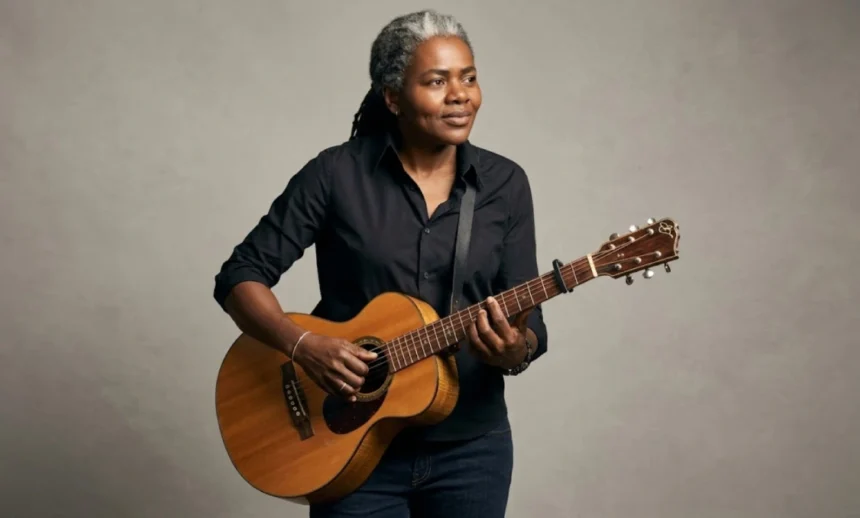
If you’re searching for Aneta Chapman, you’re not alone. Aneta is Tracy Chapman’s older sister — but she’s stayed almost entirely out of the public eye. Most people typing her name into Google are really looking for Tracy: her family, her net worth, her music, and why she reappeared at the 2024 Grammys after years of silence.
This article clears up the name confusion, walks through the Chapman family story, and covers Tracy’s career, fortune, and the unlikely second life of a song she wrote in 1986.
Who Is Aneta Chapman?
Aneta Chapman is Tracy Chapman’s older sister. The two grew up together in Cleveland, Ohio, in a working-class neighborhood on the city’s South Broadway. According to a profile from the Pop Culture Retrospective podcast, a young Tracy would play instruments at home while Aneta sang alongside her. Music was woven into the Chapman household from the start.
Beyond that, there’s almost nothing public about Aneta Chapman. She doesn’t appear in press interviews. She has no verified social media presence. Tracy herself has rarely mentioned her in any public setting. That’s consistent with how Tracy operates — she’s one of the most private figures in modern music, and her family has stayed out of the spotlight as a result.
If you came here expecting a full biography of Aneta, the public record is nearly empty. What we do know: she was part of Tracy’s earliest musical memories, and their mother, Hazel Chapman, fostered a home where creative expression mattered — even when money didn’t come easily.
Early Life and Family Background
Tracy Chapman was born on March 30, 1964, in Cleveland, Ohio, to George and Hazel Chapman. Her father was older and more educated than her mother. Hazel hadn’t finished high school when they married, and the couple hoped marriage would turn things around financially. It didn’t. They divorced when Tracy was four years old.
Hazel raised Tracy and Aneta on her own in South Broadway, a mostly Black, working-class neighborhood. The family relied on welfare at times, but Hazel had a gift — a beautiful singing voice and the ability to play guitar. She sang in church and at weddings. She bought Tracy a ukulele at age three. By eight, Tracy was teaching herself guitar. She later said she may have been inspired by watching the TV show Hee Haw.
Growing up during the desegregation of public schools, Tracy endured bullying and racially motivated assaults. Her break came through a scholarship program called A Better Chance, which placed underserved students in college preparatory schools. Tracy left Cleveland for the Wooster School in Connecticut and then enrolled at Tufts University, where she studied anthropology and African studies.
While at Tufts, she started busking in Harvard Square and recording demos at the campus radio station, WMFO. A fellow student, Brian Koppelman, heard her perform and brought a demo tape to his father, Charles Koppelman, who ran SBK Publishing. That introduction led to a deal with Elektra Records in 1987.
How Did Tracy Chapman Become Famous?
Her self-titled debut album arrived on April 5, 1988. Within two weeks, it had sold over a million copies. The real turning point came two months later, on June 11, at the Nelson Mandela 70th Birthday Tribute Concert at Wembley Stadium. She stepped in as a last-minute replacement for Stevie Wonder, who was dealing with technical problems.
That televised performance introduced her to millions. “Fast Car” climbed to No. 6 on the Billboard Hot 100. The album hit No. 1 in both the U.S. and the U.K. At the 1989 Grammys, she won three awards: Best New Artist, Best Female Pop Vocal Performance for “Fast Car,” and Best Contemporary Folk Recording.
Her career after that was a mix of commercial highs and quieter stretches. Crossroads (1989) reached No. 9 on the Billboard 200. Matters of the Heart (1992) stalled at No. 53. Then New Beginning (1995) brought her roaring back — nearly 5 million copies sold in the U.S., powered by “Give Me One Reason,” which won a Grammy for Best Rock Song. After Our Bright Future in 2008, she stopped releasing new music entirely.
| Album | Year | Billboard 200 Peak | RIAA Certification |
|---|---|---|---|
| Tracy Chapman | 1988 | No. 1 | 6× Platinum |
| Crossroads | 1989 | No. 9 | Platinum |
| Matters of the Heart | 1992 | No. 53 | — |
| New Beginning | 1995 | No. 4 | 5× Platinum |
| Telling Stories | 2000 | No. 33 | — |
| Let It Rain | 2002 | No. 22 | — |
| Our Bright Future | 2008 | — | — |
What Is Tracy Chapman’s Net Worth?
Estimates vary. Celebrity Net Worth puts Tracy Chapman’s net worth at $6 million; The Richest has estimated $8 million. The real number likely falls in that range, built across several decades and income streams.
Her debut album generated an estimated $20 million in total revenue. That figure represents gross sales, not what she personally took home. New Beginning was her next biggest earner, with estimated revenue around $4.3 million. She also toured consistently from 1988 through 2009, including a major 1990 U.S. run and a five-month world tour supporting Telling Stories in 2000.
On the real estate side, she bought a home in Half Moon Bay, California, during a career break for $970,000 — and later sold it for more than five times that price. Then came the royalties windfall: Luke Combs’ 2023 cover of “Fast Car” hit No. 1 on the Hot Country Songs chart and No. 2 on the Billboard Hot 100, generating substantial songwriting income for Chapman.
Is Tracy Chapman a millionaire? Yes — comfortably. Her wealth comes from a debut album that’s been selling for nearly 40 years, smart real estate, and an unexpected royalties boost from a song she wrote while still in college.
The “Fast Car” Revival: Tracy Chapman and Luke Combs
In 2023, country artist Luke Combs released a cover of “Fast Car” that surprised the industry. It went platinum by July, hit No. 1 on the country charts by September, and made Tracy Chapman the first Black artist to top Hot Country Songs with a solo composition.
Chapman won Song of the Year at the 2023 CMA Awards — her award, not Combs’. She didn’t attend but sent a statement: “It’s truly an honor for my song to be newly recognized 35 years after its debut. Thank you to the CMAs, and a special thanks to Luke and all of the fans of ‘Fast Car.'”
Then came the moment that captivated audiences. On February 4, 2024, Chapman walked onto the Grammy stage and performed “Fast Car” as a duet with Combs — her first public appearance in years, and the only time she’s ever performed the song as a duet. The reaction was immediate. “Tears” and “cried” became the dominant words across social media. The New York Times described the performance as a rare gift of harmony between different genres, generations, and races.
What struck people just as much was how she showed up: no entourage, a 15-minute makeup session using Black-owned beauty brands, a custom Prada shirt, and naturally grey hair she hadn’t tried to hide. For longtime fans, it was everything they loved about her — understated, authentic, entirely unbothered by trends.
Is Tracy Chapman LGBTQ? What About “Fast Car”?
This is one of the most-searched questions about Tracy Chapman. The answer: she’s never publicly discussed her sexual orientation. Chapman keeps her personal life behind a wall — no social media, minimal interviews, and a consistent redirect from personal questions back to her art.
As for “Fast Car,” Chapman has been clear: it’s fiction. “I hope everybody knows it’s not me,” she told the New York Times. “I was not, at 24, married with a couple of kids — not that there’s anything wrong with that, but this is a work of fiction.” She did acknowledge that the emotional center of the song — wanting connection and a sense of belonging — came from a real place.
The song has been widely embraced by LGBTQ listeners and carries deep meaning for many within the community. But calling it an “LGBTQ song” based on interpretation alone wouldn’t be accurate. Chapman wrote it as a universal story about working-class struggle and the hope for something better. That broad emotional truth is exactly why it resonates across so many different audiences — and why it came back 35 years later as if it had never left.
Where Is Tracy Chapman Now?
Tracy Chapman lives quietly in San Francisco. She hasn’t released a studio album since 2008’s Our Bright Future and hasn’t toured since 2009. She has no social media accounts.
Her 2024 Grammy performance remains her only significant on-camera appearance in recent years. She hasn’t followed it with any announcement of new music or tour dates. In an April 2024 interview with the New York Times Style Magazine, she discussed her songwriting process but offered no hints about a comeback.
Still, her music reaches more people now than it has in decades. “Fast Car” is surging on streaming platforms thanks to the Luke Combs connection. In 2025, her self-titled debut album was inducted into the Library of Congress’s National Recording Registry — an honor reserved for recordings considered culturally and historically significant.
For someone who has spent most of her career avoiding the spotlight, Tracy Chapman’s music has a way of finding people on its own.
Conclusion
- Aneta Chapman is Tracy Chapman’s older sister. The two grew up together in Cleveland, and Aneta sang while Tracy played instruments as a child. Almost no public information exists about Aneta’s adult life.
- Tracy Chapman was born on March 30, 1964, and raised by her mother, Hazel Chapman, after her parents divorced when she was four.
- Her self-titled debut album sold over 6 million copies, won three Grammys, and remains one of the most successful first records in modern music history.
- Her estimated net worth is $6–$8 million, built on album sales, touring, real estate, and songwriting royalties — including a major boost from Luke Combs’ 2023 cover of “Fast Car.”
- Chapman has never publicly identified her sexual orientation and describes “Fast Car” as a work of fiction, though the song has been deeply embraced by LGBTQ audiences.
- She lives in San Francisco, has no social media, and has made no public plans for new music or touring since her 2024 Grammy appearance.
If you found this through the “Aneta Chapman” search and you’re new to Tracy’s music, start with her 1988 debut. It sounds as sharp today as it did the day it came out. If you’ve been a fan all along, share this with someone who still doesn’t know the full story behind the name they keep typing into Google.